
Land Rover 86 Series I – Form follows function
Actually, the story of the Land Rover reads almost like a fairy tale. It was created almost by accident and celebrates its 75th birthday in 2023. Until 2016, it was constantly modernized, but not fundamentally changed. And by then, over two million examples had been built, more than of any other Rover in the company’s history.
However, the Land Rover was not born entirely by chance. In fact, after the war, Rover had an almost new factory in Solihull, but no new models that could be sold and exported in larger numbers. A small car design called the M1 did not prove to be the right answer to post-war demands.
Maurice Wilks, the chief engineer, had a farm on the island of Anglesey, just off the northern coast of Wales. The 62-hectare site extended all the way to the sea. In order to remain mobile on the sometimes impassable land and to be able to work, which Maurice enjoyed doing in his spare time, he used a Willys Jeep that had been decommissioned by the military. His brother, Spencer Wilks, Managing Director of Rover, is said to have asked Maurice one day in the late 1940s what he would do if the Jeep gave up the ghost.
Maurce replied that there was no alternative and that he would probably be forced to buy another Jeep. Why not produce a similar vehicle at Rover, for which there would certainly be a market, was the obvious question at the end of this discussion. And so, in early 1947, the two decided to do just that.
The Jeep served as inspiration, but was not simply copied. By the summer of 1947, the first prototypes had already been constructed. Still in September 1947, the Rover Board of Directors gave the green signal for series production.
The off-road vehicle, which was named “Land Rover” at an early stage, was to take account of the prevailing material shortages and be easy to build. For this reason, the aluminum alloy “Birmabright” was chosen as the basic material for the body. Aluminum was easy to process and weighed less than sheet steel, it was corrosion-resistant, and it was also available in larger quantities because demand for aircraft construction had declined. The body was manufactured in three separate parts that could be assembled independently of each other.
Too much artistic design input was not necessary. The decision was made to use mainly flat surfaces. Utility took precedence over aesthetics.
A cost-effective solution was also sought for the chassis. It was decided to weld steel strips together to form box-shaped components and to arrange them in a ladder frame. The result was a torsionally rigid chassis. Robust rigid axles with semi-elliptic springs were chosen for the suspensions. Braking was hydraulic with drums, controlled by a Burrman-Douglas steering system. The mechanical handbrake acted on the rear cardan shaft.
The engine chosen was the existing four-cylinder from the Rover P3. From 1593 cc, the side-camshaft engine developed 50 hp at 4000 rpm.
The four-speed transmission was also taken from the P3, but with shorter gearing and an additional gearbox for off-road use. All four wheels were driven, and the front-wheel drive could be disengaged via a freewheel clutch. In addition, it was possible to use the engine’s power in the form of a stationary drive to power a saw, for example.
The Land Rover had already been undergoing intensive testing since the fall of 1947, and 48 pre-production vehicles were built. On April 30, 1948, the off-road vehicle was then presented at the Amsterdam Motor Show. However, the car show in Holland was a manageable affair. Just 45 passenger cars from America, Germany, England, France, Italy, Sweden and Czechoslovakia were presented, 18 of which came from Great Britain. In addition, there were a few trucks and one sports car.
John Rozendaal’s coverage in “Das Auto” magazine did not mention the Land Rover. Presumably, he was simply not interested in this rustic off-road vehicle, which probably did remind him somewhat of the Jeep and the war.
Apparently, however, there was considerable interest in the new product, because many export markets, especially those with poor roads, expressed a need for it. The Land Rover had hit the mark.
Series production began in July 1948, and by the end of the year a more luxurious “Station Wagon” model with seven seats was introduced. Just one year later, the first government order for the Land Rover was received, and by 1950, 24,000 units had already been produced. Exports brought five million British pounds into the tight coffers. There was no getting around the Land Rover.
As early as 1950, permanent four-wheel drive was replaced by a system that allowed a choice between two- and four-wheel drive in the higher speed range, while permanent drive for both axles was always used in high-reduction operation. In 1952, displacement was increased to two liters, in parallel with the four-cylinder in the Rover P4.
Finally, in 1953, the wheelbase grew to 86 inches, and a long-wheelbase version with a 107-inch wheelbase was also introduced. From then on, the wheelbase in inches was part of the type designation, and the car was referred to as the Land Rover 86 or the Land Rover 107. In 1958, the wheelbase then grew further to 88 and 109 inches. Also a diesel engine was taken up as two-liter to the construction program.
The off-road vehicle, which was named “Land Rover” at an early stage, was to take account of the prevailing material shortages and be easy to build. For this reason, the aluminum alloy “Birmabright” was chosen as the basic material for the body. Aluminum was easy to process and weighed less than sheet steel, it was corrosion-resistant, and it was also available in larger quantities because demand for aircraft construction had declined. The body was manufactured in three separate parts that could be assembled independently of each other.
Too much artistic design input was not necessary. The decision was made to use mainly flat surfaces. Utility took precedence over aesthetics.
A cost-effective solution was also sought for the chassis. It was decided to weld steel strips together to form box-shaped components and to arrange them in a ladder frame. The result was a torsionally rigid chassis. Robust rigid axles with semi-elliptic springs were chosen for the suspensions. Braking was hydraulic with drums, controlled by a Burrman-Douglas steering system. The mechanical handbrake acted on the rear cardan shaft.
The engine chosen was the existing four-cylinder from the Rover P3. From 1593 cc, the side-camshaft engine developed 50 hp at 4000 rpm.
The four-speed transmission was also taken from the P3, but with shorter gearing and an additional gearbox for off-road use. All four wheels were driven, and the front-wheel drive could be disengaged via a freewheel clutch. In addition, it was possible to use the engine’s power in the form of a stationary drive to power a saw, for example.
A surprising number of the more than 200,000 Series I Land Rovers built up to 1958 have survived. Anyone who takes a seat in one experiences pure nostalgia. A driving experience almost doesn’t get much more analog than this.
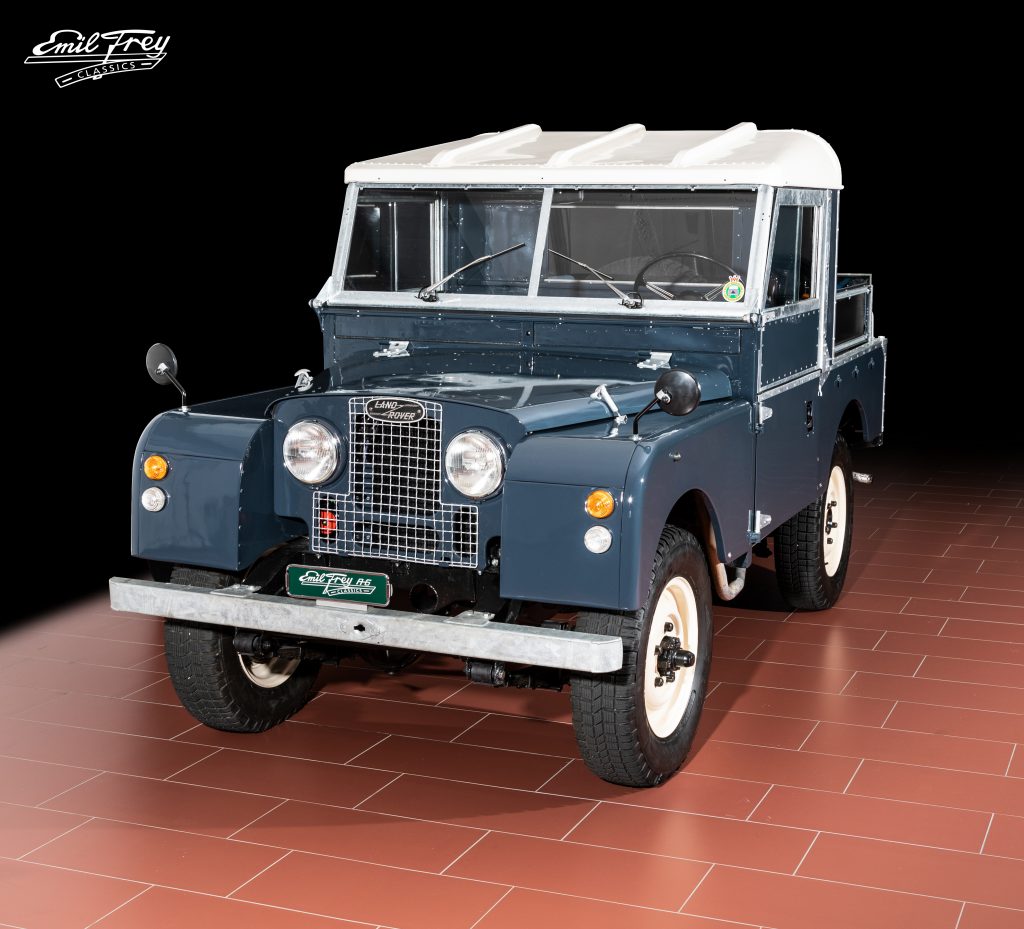
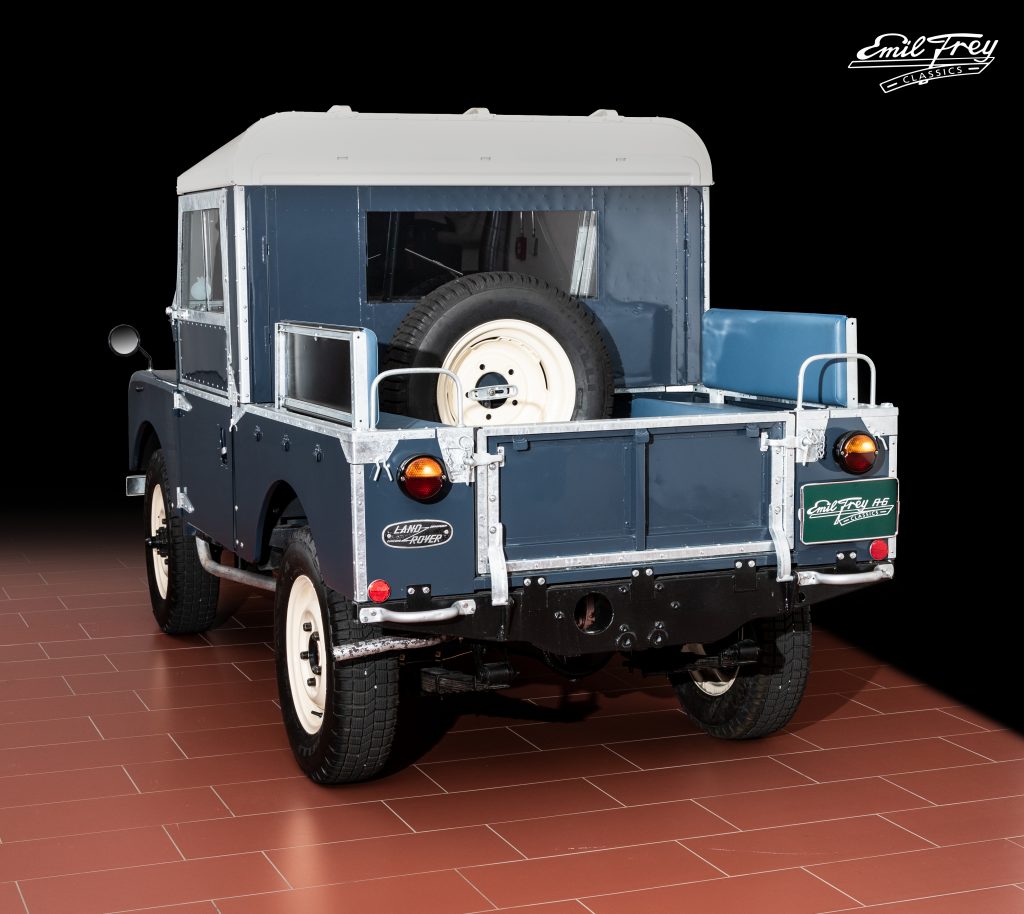
There are three seats in the front of the first-series Land Rover 86, and another four on the bench seats in the back. The fabric roof can be removed or unbuttoned in about five minutes. Only the accommodation of the canvas roof causes a bit of a headache when fully occupied. The Land Rover doesn’t want to be a sports car, but the 52 hp is enough to keep up in country road traffic.
However, its real domain – rough terrain – is hardly expected of a lavishly restored Land Rover, like the photographed example from 1955. In fact, the off-roader in the very rare, but quite authentic Navy Blue livery was so extensively restored by an enthusiast that one could speak of a concours restoration. He even rebuilt the wiring harness true to the original. Many of the original panels of the Landy, once delivered by the Sares company in Lausanne to the first owner in Treyvaux in the canton of Fribourg, could be saved.
Accordingly, the gem, which has only covered just 500 kilometers since its rebuild, is handled with care today. But even driving on paved terrain is fun in the Land Rover. You can feel the technical response to every movement, have a good all-around view and listen to the satisfied utterances of the two-liter engine.
It feels as if time has stood still. And actually it did until 2016, when the last descendant of the original Landys was built. And it wasn’t until 2020 that a much more modern successor appeared, which many Ur-Land Rover owners may not like at all. But after all, there are still some early examples.
Guest author: Bruno von Rotz
Picture and video: Michael Klauser