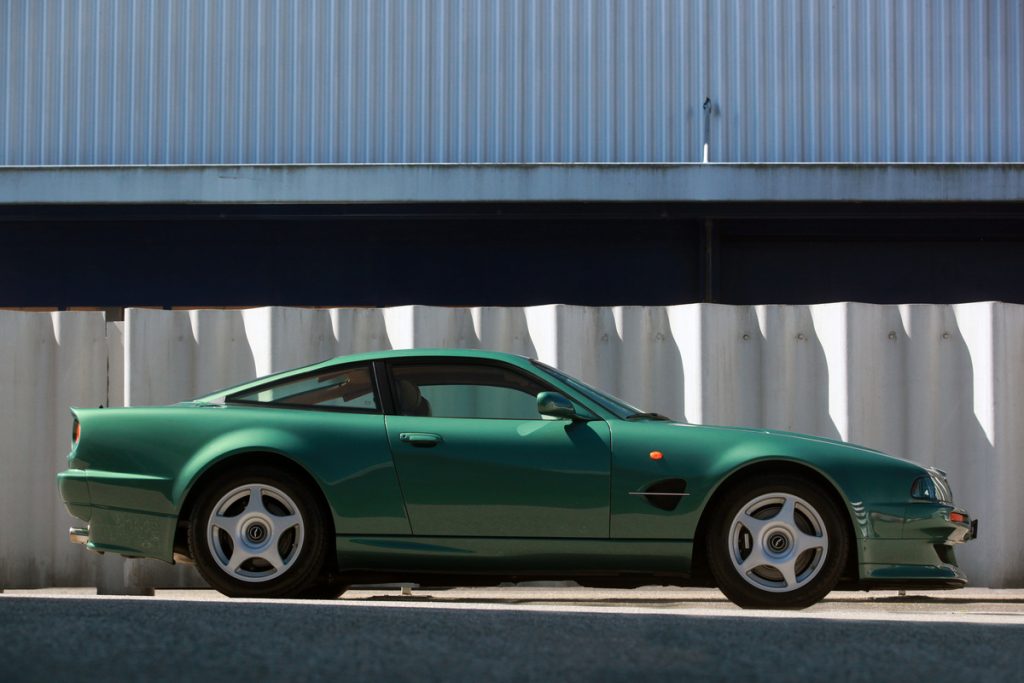
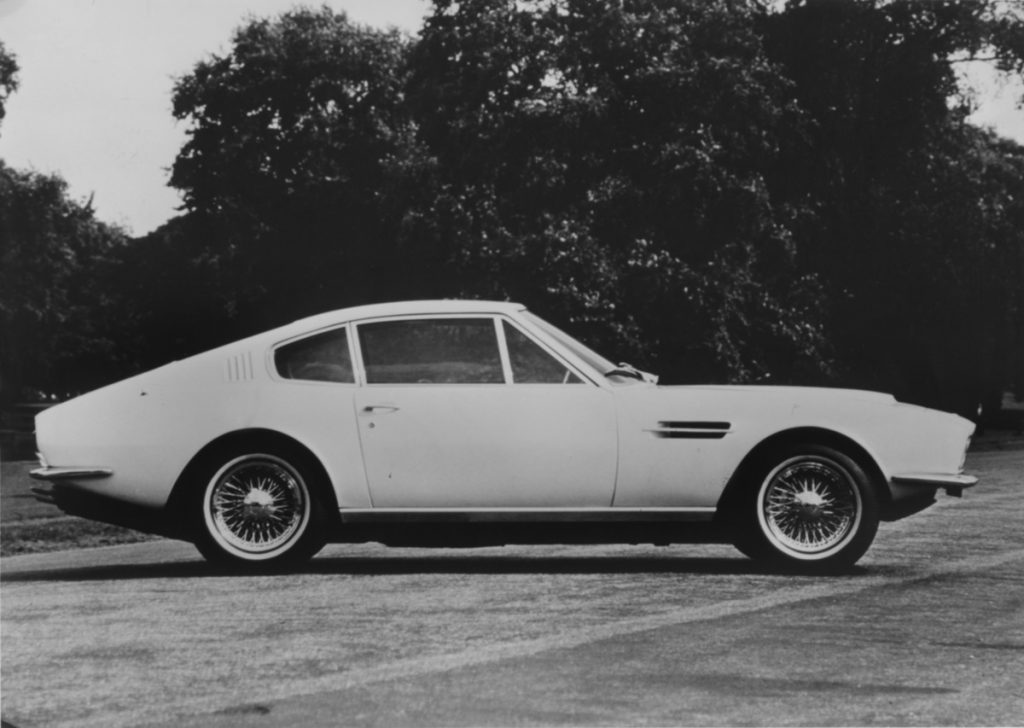
The V8 was built (in part as a Vantage variant) until 1988, when it was replaced by the Virage. While this model had a more angular design, the improved technology of the predecessor could largely be found beneath the exterior. Even the De Dion rear axle survived the model change and was produced for another decade.
In 1992 the Virage was joined by the Vantage, which differed both visually and technically. The front and rear had undergone extensive restyling, and the V8 5.3-L engine, now with two Eaton compressors, boasted 558 hp.
No half-portion
The Aston Martin Vantage weighed in at a hefty 2015 kg when it was tested by Auto Motor und Sport magazine in 1997. But the 745 Nm (at 4000 rpm) and 557 hp (at 6500 rpm) ensured enough propulsion. The Vantage could hit 0 to 100 km/h in 5.2 seconds, reaching a top speed of 281 km/h. Although the Aston was not exactly economical, consuming 19.1 L of Super per 100 km, it could not be considered a gas guzzler, either.
No clear test winner
Despite its performance advantages, the Aston could barely measure up to the competition out of Detroit or Maranello – at least objectively speaking. The Ferrari F550 Maranello could accelerate more quickly, reach a higher top speed by 36 km/h and weave through a slalom course 20 km/h faster. In a comparison test against the Chevrolet Corvette, Dodge Viper and Ferrari F550, the Aston came in last. Only in the body category could it catch up to the Ferrari.
But such rankings probably had little effect on typical Vantage buyers, including Tom Cruise and Prince Charles, who would have never opted for a Corvette over the elegant Aston Martin. The Vantage interior, made from at least 11 cowhides of Scandinavian origin, brimmed with classic British style. Everything was handmade by masters in their field, and not in a matter of hours but weeks. Even the large series parts from Ford and GM did not tarnish its image. If you were a gentleman who could afford it, you simply drove an Aston, not a Corvette.
The boys at Aston Martin in Newport Pagnell, England, ended up retrofitting the Vantage, even if lagging performance was hardly the reason the Aston Martin could not match the Ferrari 550 Maranello.
V550 and V600
From 1998 onwards, Aston Martin customers could bring their Vantage back to the factory and order a V600 performance “cure”. The cure, at a cost of around £20,000, upped the horsepower to 608 hp at 6200 rpm and the torque to a whopping 813 Nm.
It also significantly cut down the sprint from 0 to 100 km/h to under five seconds. From then on, the “normal” models were sold as the V550.